Just a grab-bag of mutants from other RPGs, many of these are just not really tested.
Blue Planet
Just a grab-bag of mutants from other RPGs, many of these are just not really tested.
Blue Planet
Trying to reinterpreted Gorezone for the smaller SLA Industries 2nd Edition setting.
Gorezone - Live In Your TV, Live In Your Street, Live In Your Livingroom!
What is Gorezone?
In the over the top and dystopian SLA Industries, Gorezone was a TV show where they sealed off a sector and opened all the hatches to the sewers and maintenance tunnels, letting all the monsters up and out. While also sending in Contract Killers (murderous gameshow gladiators) and promient criminals turning up. The players could participate, help manage the chaos or be doing set up or wind down. The problem with this idea, is as the giant city of Mort Central has shrunk from Earth-sized to Germany-sized to about the size of Belize (but denser and taller). The idea you could just ruin and kill off a whole city/neighbourhood-sized region as a regular TV show became more farfetched. The vague notion was the the population either fled or tried to ride it out, but there was no indications for or against warnings.
I tried reworking Gorezone from clearing out a sector no one will miss to a last-ditch effort to squeeze every drop of evil out of a sector they've given up on, with the twin rollers of fame and violence. Thinking back to a line in the corebook about how a sector or a few had actually ejected SLA Indutries and was some locked-down nightmare.
My version of Gorezone is not a frequent event, it's a purge of a sector dressed up for television. Designed to exploit all the psychos' desire to be recognized that SLA Industries has implanted in the populace. A Gorezone involves baiting every idiot and monster out and killing them while flashing lights are going off to make other people want to do the same.
Technically correct and publicly listed; Gorezone is a combination of a standard mass-combatant deathmatch with a hunting match-up. Contract Killers arrive in a sector with the express purpose of scoring points by eliminating each other (Life After Death on standby) and killing hostile threats that reside in the sector. Needless to say this brings all the crazies out, encouraged by broadcasts showing serial killers, props, gangs and Darknight agents running into the street to do battle. Most of these have been unwillingly flushed out of their holes by Contract Killers going down Shiver hit-lists or Op teams feeding intelligence to media managers, but it's had the desired effect of getting the reprobates to emulate TV and charge for the 5 minutes of fame. Darknight even has made it policy to try and show up the corporation when it happens with it's own media stars. Carrein, carnivorous pigs and other monsters also emerge more because the streets are awash with blood. Ops get the awful job of flushing the out or baiting them to the street-level if they won't come on their own.
Shivers concentrate on keeping the violence contained to the sector, protecting assets and maybe rescuing people if there is time. Ops and Contract killers can make goodwill by valiantly stopping all the violence from breaking into the residences and businesses while on camera.
Gangs are a problem because they are often considered a lethal plague (so Gorezone kills them) but at the same time are local kids (It rates bad with armed locals). It ends up that the kids with homes just hide like the rest of the civilians and the homeless (because SLA in always unfair) or crazy ones step outside for their 5 minutes.
When I made an analysis of Pendragon 1st Edition as a sort of domain-level sourcebook for Runequest 2nd Edition, I assumed that each hide had to be producing £2 to equally split it between landlord (the knight or professional warrior) and the tenant. Since there was a floor to the amount a tenant could be earning before they couldn’t even afford gruel and beer around 500L. As gruel and beer were sold in Pavis for 2c each and should make a profit of 50% and so cost a household 1c to make each. And therefore, £1 was 500L.
But what I hadn’t accounted for was the lands worked in
Pendragon would be the private demesne of the lord, with the tenants working
their own strips of land as well independent of the lord’s hides and so the £1
per hide was not being split. And the single mention in the money section that
a family eats about £1 in food per year.
This threw out the calculations, but I still had the floor since
a family getting 50% of the produce in the Orlanthi system, would need around 500L.
If that’s 50% of a hide, I was back to £1 being 1000L.
But a peasant family eats 2 ½ d every week and eats well. The
amount eaten is either 10L (if 500L) or 20L (if 1000) depending on which value,
because in Pendragon 1st Edition, £1 is equal to 125d (1d equalling 4L
or 8L respectively). 2 ½ d every week comes 42 x 10 or 42 x 20, 420L or 840L.
Both don’t work with £1 being a nice round number like
because they can’t take into account the 20% of taxes paid to the Earth/Air
temple, which match well to Church/Liege taxes and fees and pushes then to 504L
and 1008L.
But, 2 1/2d x 52 gets 130d, which is 5d over £1. Meaning
there’s some extra money for food coming in that Pendragon is not accounted for
and we can simply ignore the same for RQ. Maybe Easter/Sacred Time has a
collective pooling of resources from the rich to the poor or something.
Household Knights sustain themselves on £1 as unmarried warriors
living on their lord’s largess. The price list lists 125d (£1) for staples for peasants
and another £1 as annual cost of living for Peasants. It seems obvious these
are the same as no where else does a Knight have to buy their own staples
unless buying more than what their estates give them.
Going back to the Pavis food price lists, and assuming a family
of farmers can make the food and drink at half cost, 6c is a Cheap Wholesome
Meal and a Mug of Ale is 4c, total of 10c per member per day. Half that, is 5c
per family member for 7 days, to get us 17.5L, or just enough to be covered by
20L with 2.5L summed up for feasts or buying meat animals. Which means 2 1/2d
is 8L and so £1 is 1000L.
A farming family in Glorantha makes 1000L in a year, eats or
trades 840L (105 being used for purchasing) and pays 160L in tax.
We must reevaluate how each culture handles land ownership and their warrior
class. This supplants the specifics in the previous blogpost.
Now an Ordinary Knight requires £2 per year to maintain
himself and his family for his station. That’s still 2000L per year.
Western Culture works exactly like the default
culture of Pendragon, Prince Valient- esque. The lord has his fields, the peasants
have theirs and work his as well.
Orlanthi Culture needs to split the farmland up more.
Since each knight is getting only 50% for each hide. But fits more.
An adventurer in Orlanthi culture can farm their own land of
1 hide and get £1/1000L per year from it, but they can only train for a
maximum of 2 hours a day, 4 hours daily during Dark and Storm Seasons. These
people are called Carls, and if they are called to fight, they fight as Poor
Knights. Carls do not have a penalty to Horse Survival Rolls but also only own
1 horse, if they own more they start rolling with a penalty for being Poor
Knights.
As Orlanthi need twice as many Hides or (x2 -1 Hides if also
self-farming) to support themselves as a knight, each Tenant family must be
working half a hide or 40-60 acres on their own. This is reasoned by the notion
in Pendragon 1st Edition that a Landed Knight lives on a simple
homestead with two hides and 1 hide supports 1 family. So, there are probably two
other peasant in the Western tradition farming their own two hides and coming
to do the extra labour. But for Orlanthi, the ownership of all four are split
between the lord and the tenants.
Any odd Hydes or Hyrds (Pendragon 1st Edition) must
be passed off to Carls, who do count towards the minimum number of Knights for
higher ranks.
So, each Hide split with a tenant also produces 1 Footman/Man
At Arms free of charge. But Orlanthi must pay for any extra. Those coming out
of the Cottars class, who form the basic labour pool for the Carls and landed
warriors. This does incentivise the Orlanthi to either raid to obtain the £s
needed to maintain extra warriors like Humakti and warbands of Household
Knights, or to invest into more rules-ethereal money-generating ventures that
produce Goods and Tolls.
Praxian Culture is fine as it is, if a little one
note for how much they care about their herds.
Pelorian Culture, I wrote that the landlords own all
the land and hand it out to the Knights and farmers as non-hereditary grants or
pay them wages. This statement means that each landlord must have a lot of land
available and a lot of wealth. Based on what I wrote before, each rank needs
twice the minimum requirements of wealth to count. But half goes to the peasants,
so it is immaterial except for advancement/bookkeeping purposes.
Bawahayat - Ag World suffering from racial tensions
The only planet of any note in Matastelsel is Bawahayat and it's the sole planet that is life-sustaining, despite it's inhospitable atmosphere. With a frozen and airless surface covered in with large crystalline structures. These are the equivalent of photosynthetic organisms, but they pump oxygen into the soil and not the air. This has allowed the evolution of massive fungi-worms, slowly crawling through the tunnels and chasms below the permafrost.
The planet is in an uproar because of racial and religious tensions between the surface (Mataknecht) and underground dwellers (Gelapknecht). The Mataknecht man the few spaceports and crystal-harvesting operations, they live in sealed and buried domes under the machinery and so see light more frequently. They tend to be the Emperor's Divine Specter Sect like those on Hiveworld Chiron.
Gelapknecht traditionally harvest and process the enormous fungi-worms into high-quality tallow (candles) and lower-quality protein-starches (food). They live in the dark tunnel-cities and don't use light beyond the faint glows of machinery, fire and bioluminescent. They have a few cults about the Emperor being the source of light and the Emperor speaking not just for or through Humanity but the worms as well.
This is maybe within the tolerances of the Ecclesiarchy/Adeptus Ministorum for the Imperial Cult, though some of the Mataknecht think the later may need to be checked. As the Emporer speaks for the holy human form and only at a stretch should cover terran animals, let alone xenos. An attempt to request a synod on the matter from Vito has gone nowhere, due to more important matters.
To forestall recruitment tithes for Warworld Ajax. The governor (Mataknecht) commissioned a genetics report that the Gelapknecht may be progressing into a Nightsider abhuman type and should therefore be exempt.
This started the riots. The Gelapknecht have long been told the tallow they make is for the benefit of humanity and it's their duty to labour in the dark. Now they demand they also get a share of the candle shipments to forestall their degradation. This also fuels the preexisting violence and mistrust between the two communities. Lynching of Voiddwellers as mutants has prompted the system's Chartist Cartels to demand action be taken or they will slow shipments of candles first, then food.
Also 5,000 years of intensive biomass extraction means new critical nutrients are needed. Asteroid bombardment or guidance is best option. This is naturally the purview of the Chartists, who feed off the asteroids and comets while also supplying crews for the few spaceships used as system patrols. But the risk is for the govenor, that such life-bearing asteroids could "slip" and strike a settlement or area of the Cartel's choosing.
Alternate Setting - Lancer 10% or Decimal Lancer
This was some brainstorming from years ago, while sitting at a stop, typing on my phone and waiting to ride to university. Just trying to turn Lancer into a more conventional FTL-based Sci-Fi universe and aliviate some issues people were saying with the scale.
Removing the hundreds column from all the dates shortens time and makes its so every year there is something happening. Maybe cultural evolution on isolated colonies is time compounded by remoteness.
This also requires dividing all travel times in the book by 10. Maybe even populations too if you really want a frontier setting.
This really changes the tone of the setting. If populations are the same, the birth rate is really high or fewer people died during the Fall. Most planets look somewhere between Nigeria and 50s America in terms of people vs economic growth. If only 10% of the popualtion of the default setting, the sin of the 2nd Committee was spreading humanity out too thinly in a rush for territory.
This also changes the dynamics of Lancer deployment, a Union battle group will deploy Lancer battalions to the most effective location even when they will consist of a very small fraction of the armed forces. When a planet’s population is 300 million and not 3 billion however, the number of vital strategic locations and opposition forces decreases, making Lancers more effective for their size.
Much more of an anime/Battletech vibe when 5 mecha suits are enough to conquer a planet.
Union politics will probably play a greater role in a campaign since it is happening much closer in time and travel to the game location. Since it has only been 500 years since Union emerged and with life-extensions and time dilation. Effectively, the entire Cosmopolitan population from the 2nd and maybe the 1st Committee is active somewhere. This increases internal tensions within the Union between those who were positive or negative towards the 2nd Committee’s methods. The 2nd Committee Cosmopolitans outnumber the 1st Committee ones, but the alive 1st Committee were able to join up with the 3rd Committee ones to oppose them.
Regardless of time dilation and increased speed, the amount of time to travel to and from a problem on top of solving it is huge. So most Union bureaucrat probably will spend a significant part of their careers on several subcommittees at once with each subcommittee focused on one hotspot and resolution. Creating a gameplay opportunity for all kinds of bureaucratic mix ups and farce, though probably not to PARANOIA levels of incompetence.
This requires a new intermediate form of FTL travel. Skipping, where one moves 10X faster than .99c in overall bursts but still suffers time dilation.
Witha new lore framing like this:
Used since before the Fall, Skipping costs a lot even to a post-scarcity civilisation. First the exact movements, slowdowns and energy must be calculated by AI or batteries of NHP, then a tremendous amount of energy and Para-Casulity infrastructure (the Launching Frame) must be used to “skip” the ship towards the target. Get anything slightly wrong and the fatality rate is 10%, with ships dissolving into subatomic particles and at best, suffering severe material stress. This was fine for the “Glorious Ascent of Mankind to the Stars” under the 2nd Committee but modern authorities prefer the safer and faster option of Blink Gates.
For a Union fleet, the amount of calculations for every individual ship, to keep them grouped together, undamaged and maybe to return is so great that GALSIM must be temporary put on hold for the 5 Voices to do the calculations. This is a blindness that the Union is loathed to have. So it has been enacted only thrice: twice for the 2nd Committee to deal with the Karrakin and Hercynia and now by the 3rd Committee for Cornucopia.
Skipping is still used, mostly by Colonies and Corpo-States which have not yet been upgraded to a Blink Gate and persist in years long, second-tier networks linking to a Blink Gate enabled system. Modern Skipping is far safer as the ship is able to coordinate via the Omninet between the NHP at each end and onboard to ensure that the calculations are accurate and fast. However it still requires tremendous output in energy to achieve. Manna is still valued in these networks as currency since the cost and time of travel keep the economy material focused. (Think Traveller or Alien).
Worlds years beyond even this network are reliant on a few unattached traders who can afford the social costs of spending years if not decades objectively, separated from home and who hold a monopoly on off world goods. A tactic many employ is the change crews at their destinations, using a NHP at each end or even onboard to keep track of essentials and effectively making each voyage a working passage to a new home.
However expansion to new colonies requires either dangerous single-end Skipping or a relatively slow crawl at .99c. And while the Union can afford to spread out at a measured pace, many states wish to expand faster and hav the capacity, if not the accuracy to do so.
Saling south from the monastery island in 07.05, next to Flodaigh, though they don’t know the name). The weight of the undead clinging beneath the hull counterbalanced the strong winds they had. They wisely remembered the warning of their dead indentured and beached one hex to the north of 06.12.
Sigmar
begins the process of meditating as they sailed, trying to gain a Virtue of Law.
The next
day they sail into the harbor of Blulach. To the fort that guarded the harbor
and docks, Sigmar unveils her wings and commands the lord’s presence. Taking
advantage of being Myyrrhn. Glas is right down, Sigmar still does not speak Ruis or Bythonic, but
Althrow Tams can translate. Good rolls.
Glas’s cousin, Guaire, the
Bishop of Blulach arrives. He immediately offers 1000sp for them to remove the mud-immortal
coven, even as the party were not entirely sure why they hated them besides religion
and eventually decided it was because the coven was impeding traffic.
They further
offered the Glas and Guaire another 1000sp of treasure. Selling four of the
five rare perfumes from Donashoe and the religious icons. The bishop thought he
could rework them into depictions of Faith triumphant over paganism. They didn’t
have another 1000sp handy to give the party. So, instead they offered a 1000sp
town credit. About buying a new boat, the town only had a couple of karvis
and would part with them for 3000sp. They players wanted a snekkja as it could
fit the entire crew (living and dead). They found out they did not like Druids here.
Hranfkel tried to ransom Yrestor/Yrestar (forgetting he
is not a smaller SIZ). The player made all sorts of claims that Yrestor was a
noble (right), heir to a fortune built on steam engines (false) and that great
riches could be extracted from his family (on another plane-false). A Viking local
to the plane making these claims, I let him ramble for a bit before Glas cut
him off with a an unimpressed, “No”.
In an afternote, I looked up a snekkja and it’s not much
bigger than a karvi, just broader while a karvi can be longer but thinner.
The rowers
were paid, for they had landed in a town and the credit was spent on fireproof gloves
(10sp) so Althrow Tams could wield the fire elemental as a flaming weapon. Many
other supplies were bought, most perishable.
Setting off
without the rowers, south to the ford. The mud-immortals thickly coated in the
grey stuff, with heavy limbs and only a few small eye and breathing holes in
the faceless mass. Yrestor decided to walk up and pull the hardened mud off one.
STR vs STR resistance, roll he yanked the mud off the unexpecting immortal to
reveal the aged and raw face beneath. The immortal started to scream.
The immortals
were slow with their limbs cacked and the edges/weight painful, but Hranfkel leaped
upon one, not ambush, it faltered and weakened. The battle was another slog,
with the hardened mud being as good as plate armour and the blows being 1d6 +
1d4. Yrestor was beaten so badly, he fell to 0 HP with a critical hit (scar
only). This prompted a debate about whether death was beyond or at 0 HP. I
decided on a roll of POW x 5%, which he passed.
Althor Tams fire elemental was able to immobilise for a turn
by baking the mud. Slowly each was felled, though Hranfkel’s axe did the best. Weakening,
hitting critical more often and great damage.
Afterwards, a successful First Aid roll meant Yrestor did
not die. The party inquired about the axe. Miklas Domonkos, being a weaponsmith,
tested the blade with a finger. The player suspicious were confirmed when we
had to hurriedly go through the Strength draining rules, but luckily found the rule
that it was an ability that could be active, so Hranfkel did not wish it.
Returning, they rested for 2 weeks, noting that was as long
as they had spent since arriving on Ruislip itself.
Still looking for more money, Glas and Guaire offered to
build them a snekkja in repayment for finding and ending the iron-blooded
corpses from up the river. The party liked the idea.
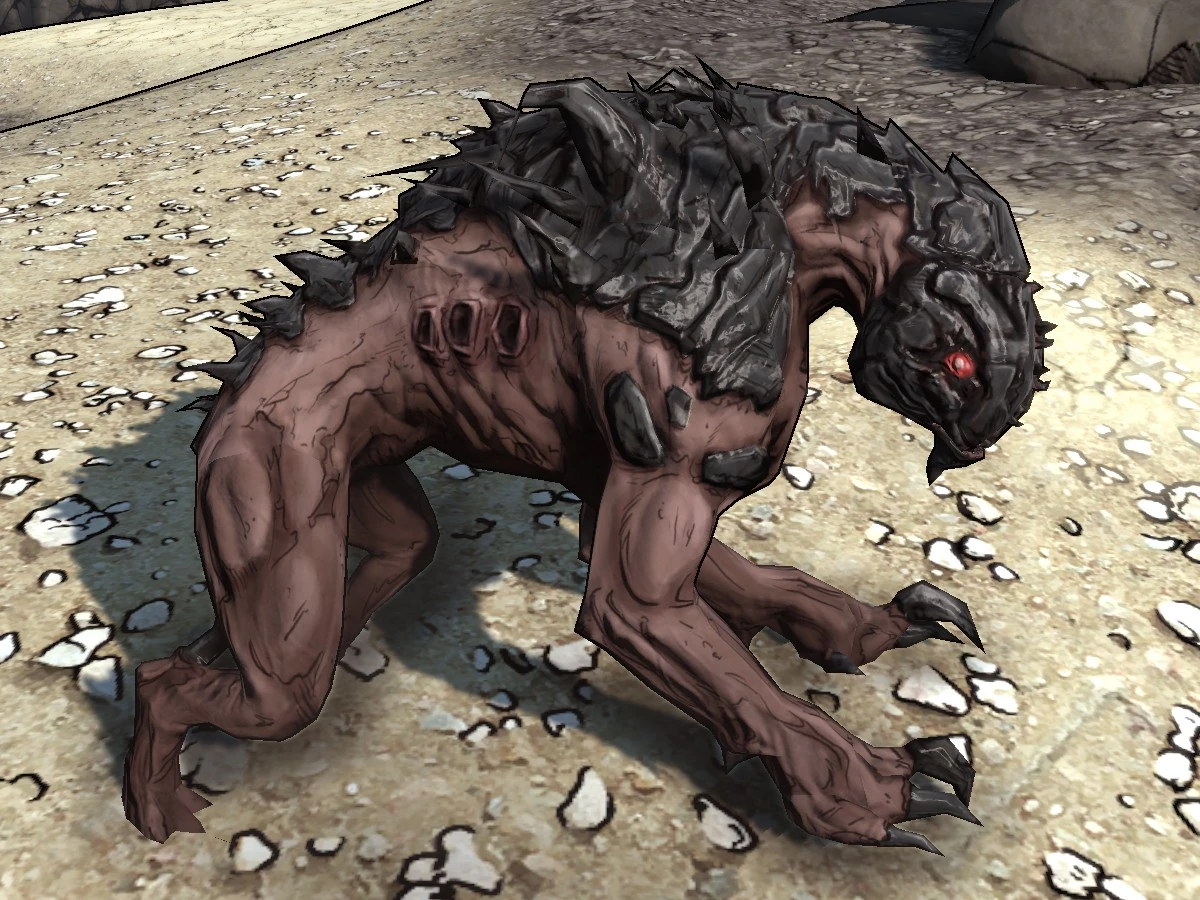
As part of my tinkering with the Mutants in the Now ruleset, I settled on creating some fictional speices, some from Blue Planet and some from the Borderlands video-game franchise, due to both settings' focus on the violent ecology of their planets. Violent creatures being surpisingly easier to make then trying to specialise herbivores and more normal animals. A legacy of being based on Palladium's RPG and hence AD&D.
I made skags first but never really had an idea to fix their growth. Species in Mutants in the Now (in the Mutants in the Next book) can metaphorph to adult forms and age, but nothing suggests changes after they achieve adult forms. Skags get bigger and more armoured the older they are, with the largest types developing a laser beam. But they don't morph shape very much. I could just discount Skagzilla as a one-off creature had not another giant, aged but apaprently normal skag done the same in Borderlands 2.
I ended up truncating some of the changes and tied them to the aging rules, leading to the odd situation where they get weaker as the reach their monstrous final forms. This may all be edited later after feedback.